
 English
 Español
Submitted by Melissa Vidito on
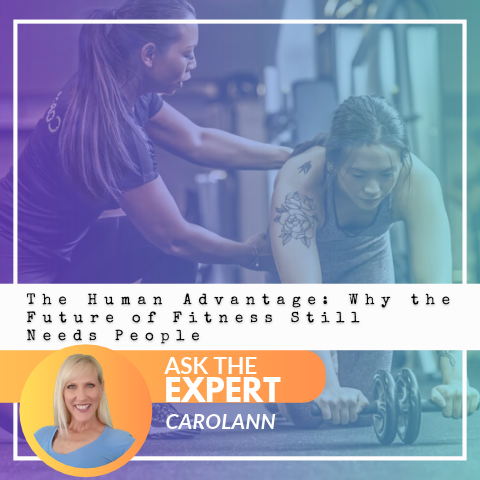
Written by: CarolAnn, MS, CPT, NCPT
AI can write a workout, track someone's progress, analyze their data, and even guide them through an exercise. The value of the fitness professional goes beyond exercise information. It's the human being delivering the experience.
Artificial intelligence is rapidly changing the fitness landscape. Clients can access personalized workouts, exercise demonstrations, wearable-data analysis, nutrition information, progress tracking, and motivational prompts without ever walking into a gym. Technology can process enormous amounts of information in seconds. But information has never been the entire reason people exercise or the reason they keep exercising. The future of fitness belongs to professionals who understand that their role is evolving. The fitness professional is more than an information provider: a coach, interpreter, relationship builder, and behavior-change catalyst. Here are five areas where the human advantage matters most.
1. Coaching: Turning Information Into Action
Knowing what to do and actually doing it are two very different things. An app can tell a client to perform three sets of squats. AI can generate a progressive strength program. A wearable can tell someone they have been inactive for eight hours. But none of those things necessarily answer the most important question:Why isn't this person doing it?
Human coaching addresses the barriers behind the behavior. Is the client intimidated? Bored? Overwhelmed? Afraid of injury? Struggling with confidence? Dealing with a stressful week? Or simply not enjoying the prescribed exercise?
Research supports the importance of these human factors. In a one-year study of 250 novice fitness club members, enjoyment was the strongest predictor of whether they continued to attend regularly. Participants who reported greater enjoyment were significantly more likely to maintain their exercise routine. Confidence in their ability to “stick with it” was the next strongest predictor, while social support from friends and family also played a positive role. [1]
The implication for fitness professionals is significant. The job isn't simply to prescribe exercise. The job is to help people successfully engage in exercise. That requires coaching. A skilled professional can adjust both the workout program and the approach: change the goal, make the session more enjoyable, build confidence, reduce intimidation, or help a client reframe a setback. Technology can suggest a program. People bring a personal connection to coaching.
2. Interpretation: Data Is Only Valuable When Someone Understands the Person Behind It
Today's fitness professionals have access to more information than ever: heart rate, sleep scores, training loads, step counts, recovery metrics, body-composition measurements, and exercise history. But more data doesn't automatically create better decisions. A wearable might show an elevated heart rate; however, the professional can consider factors such as poor recovery, dehydration, anxiety, heat, or an unusually difficult workout, and recognize when referral to an appropriate healthcare professional may be warranted. A client might report fatigue. Is it a sign to reduce training intensity? Change the exercise selection? Address recovery? Or modify today's session based on what else is happening in the client's life? The numbers provide information. The professional provides context.
This interpretive role becomes even more important as technology becomes more sophisticated. Fitness professionals don't need to compete with AI at processing information. They need to become exceptionally good at interpreting information within the context of a real human being. Research on exercise adherence reinforces this point. A 2025 systematic review found that human coaching, when used alongside digital tools, was associated with greater engagement, motivation, adherence, behavior change, and personalization. [2]
The future professional will be less focused on simply collecting data and more focused on knowing what the information means and what action makes sense for this individual. That interpretation of data requires observation, communication, and professional judgment.
3. Relationship: People Are More Likely to Stay Engaged When They Feel Supported
Fitness is often discussed as if adherence were simply a matter of discipline. It isn't. Human connection can play an important role in whether people continue participating. Referring back to the one-year study of novice fitness-club members, social support was positively associated with regular exercise attendance. By 12 months, people who reported stronger social support were more likely to still be exercising regularly (r = 0.25). [1] That may seem like a small connection, but it reinforces an important point: people are more likely to stay engaged when they don't feel like they're doing it alone.
A separate study of individualized small-group personal training found that satisfaction with the training experience was associated with greater exercise self-efficacy and autonomous exercise motivation, while autonomous motivation was associated with greater self-reported health, energy, and life satisfaction. [3]
This is where the fitness professional has an enormous advantage. A client isn't simply another data point on a dashboard. The professional knows that Susan missed Tuesday because life became complicated. They know that Marcus is nervous about increasing the weight he lifts after a previous injury. They notice when Jennifer walks into class unusually quiet. That accumulated knowledge creates something technology has difficulty replicating: relationship. People don't just want to be told what to do. They want to feel seen, understood, and supported. And that matters because exercise is a behavior that has to survive real life.
4. Behavior Change: The Workout Is Often the Easy Part
Fitness professionals sometimes spend enormous amounts of time perfecting the exercise prescription while overlooking the behavior that determines whether the prescription ever gets followed. The real challenge may not be designing the perfect workout.
It may be helping the client:
- Make exercise a priority
- Build confidence
- Overcome all-or-nothing thinking
- Recover from missed workouts without quitting
- Find activities they actually enjoy
- Set realistic expectations
- Navigate setbacks
- Create routines that fit their lives
This changes how we should think about the fitness professional's job. A workout can change a person's body; coaching can change a person's relationship with movement. That distinction matters. The professional who understands behavior change can help a client move from "I have to exercise" to "I am someone who exercises."That is transformation.
5. Human Connection: The Experience Is Part of the Product
There is another reason the human professional will remain relevant: People don't only buy results. They buy experiences. Think about why someone chooses an in-person Pilates class when they could stream a Pilates workout at home. Why does someone hire a personal trainer when thousands of workouts are available online? Why does someone return to the same instructor week after week? It isn't necessarily because that instructor has access to exercises that cannot be found somewhere else. It's because the experience matters.
A systematic review looked specifically at adult group fitness classes and exercise adherence, including social connection, instructor behavior, enjoyment, self-efficacy, and group identification. The review included 21 studies and found that adherence in instructor-led group exercise was influenced by social-relational processes, instructor-shaped motivational climate, perceived capability, and affective experience. In particular, social attraction, social cohesion, group identification, and certain instructor behaviors were more consistently associated with adherence than generic measures of social support. [4]
Technology can deliver a workout; people can create experiences that keep clients coming back and support greater adherence.
The Fitness Professional's New Competitive Advantage
The rise of AI shouldn't make fitness professionals afraid of technology.It should challenge them to become better at the things technology cannot easily replace.
- Use technology to support your work and make more time for the people you serve:
- Use AI to generate ideas.
- Use wearables to collect data.
- Automate administrative tasks.
- Use digital platforms to extend your reach.
At the same time, strengthen the skills that help you connect with clients and class participants:
- Observe how they move and respond to coaching.
- Listen to their goals, concerns, and challenges.
- Communicate clearly and offer useful encouragement.
- Apply behavior-change strategies that support consistency.
- Individualize your approach to meet different needs.
- Recognize when someone needs a challenge—and when they need compassion.
- Turn data into decisions that reflect the person behind the numbers.
Most importantly, learn how to build relationships that make people want to come back.
The fitness professional of the future isn't simply the person who knows the most exercises. It is the professional who can take information, interpret it through the lens of an individual human being, create an experience that matters, and help that person make meaningful changes. AI will continue to become smarter. Workouts will become increasingly personalized. Wearables will become increasingly sophisticated. Which is precisely why the fitness professional has an opportunity to become more valuable—not less. When information becomes abundant, human connection becomes a differentiator. AI can provide information, but fitness professionals provide transformation.
Learn how to apply these soft skills and become an effective fitness professional through the FiTOUR Group Fitness Instructor and FiTOUR Personal Trainer Certifications. www.FiTOUR.com
References:
Gjestvang, C., Abrahamsen, F., Stensrud, T., & Haakstad, L. A. H. (2021). What Makes Individuals Stick to Their Exercise Regime? A One-Year Follow-Up Study Among Novice Exercisers in a Fitness Club Setting. Frontiers in Psychology, 12, 638928.
Loughnane C, Laiti J, O'Donovan R, Dunne PJ. (2025). Systematic review exploring human, AI, and hybrid health coaching in digital health interventions: trends, engagement, and lifestyle outcomes. Front Digit Health. 2025 Apr 24;7:1536416. doi: 10.3389/fdgth.2025.1536416. PMID: 40343215; PMCID: PMC12058678.
Wayment HA, McDonald RL.(2017).Sharing a Personal Trainer: Personal and Social Benefits of Individualized, Small-Group Training. J Strength Cond Res. Nov;31(11):3137-3145. doi: 10.1519/JSC.0000000000001764. PMID: 28353489.
Gao, X., Song, Y.-G., Shu, Y., Silva, A. F., & Greco, G. (2026). Perceived Capability, Social Belonging, and Behavioral Adherence in Adult Group Fitness Classes: A Systematic Review of Psychosocial Predictors. Behavioral Sciences, 16(6), 882.